
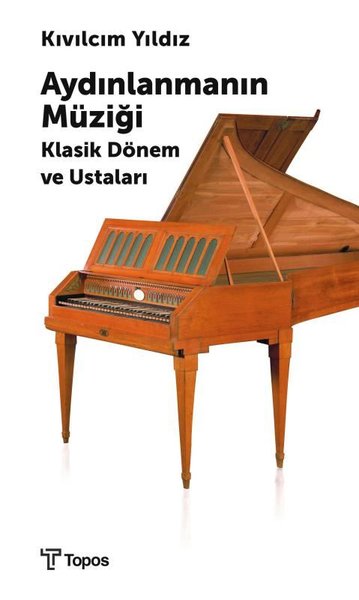
The Music of the Enlightenment: The Classical Period and Its Masters
Yazar: Kıvılcım Yıldız
Brand: Topos Yayınları
Basım Tarihi: Eylül 2020
Basım Dili:
Sayfa Sayısı: 207Boyut: 13.5 / 21.0 cm
In stock
9786056986611
Product Description
Kıvılcım Yıldız wrote "The Music of the Enlightenment"...
"The Music of the Enlightenment - The Classical Period and Its Masters," published by Topos Pocket Books, which began its publishing life with a music series, is authored by Kıvılcım Yıldız. Yıldız's work is the second book of Topos Pocket Books, under the general editorship of Aykut Köksal.
The book, following chapters titled "The Classical Period and the Enlightenment" and "Classical Style in Music," includes a chapter titled "Viennese Classics," which focuses on Haydn, Mozart, and Beethoven. Erdem Çöloğlu, who wrote an afterword for the book, states: "The Classical style in music coincides with a period when the rational thought represented by the Enlightenment gained strength, and historicity, which would gain its identity in the middle of the next century, emerged, reflecting these values. On one hand, it devalues the counterpoint technique at the core of the previous style and the polyphonic textures it created as an engineering effort contrary to the prevailing principle of simplicity of the period. On the other hand, in an environment of relationships that 19th-century theorists would define as dialectical, it places functional tonality, the increasingly dominant phenomenon of the period, at the center of instrumental music. Of course, it develops new techniques for these purposes. Simplification on the harmonic plane occurs with homophonic textures, where melody and accompaniment are derived from the same sound material, replacing polyphonic textures. In this way, a new hierarchy emerges, guided by functional tonality and 'functional' form. This hierarchy allows for the design of much wider tonal regions than what we observe in the Baroque style. The possibility of modulation to distant tonalities brought by the new tuning system allows for longer work durations and enables the establishment of contrast and similarity relationships between large plans in the structure. Thus, as a result of the interaction between this hierarchy and the dialectical relationship, the sonata form, which is the common formal source of leading genres such as symphony, concerto, and sonata of the period, is born and develops.
Kıvılcım Yıldız describes this process in detail and avoids referring to technical musical terms like sonata form, theme, and tonality as abstract/cold terms. Instead, she addresses them as an organic part of music history, placing them within a historical and social framework and emphasizing the historical continuity we mentioned above. Furthermore, she demonstrates that changes in supply and demand dynamics lie at the root of musical design and technical choices."
