
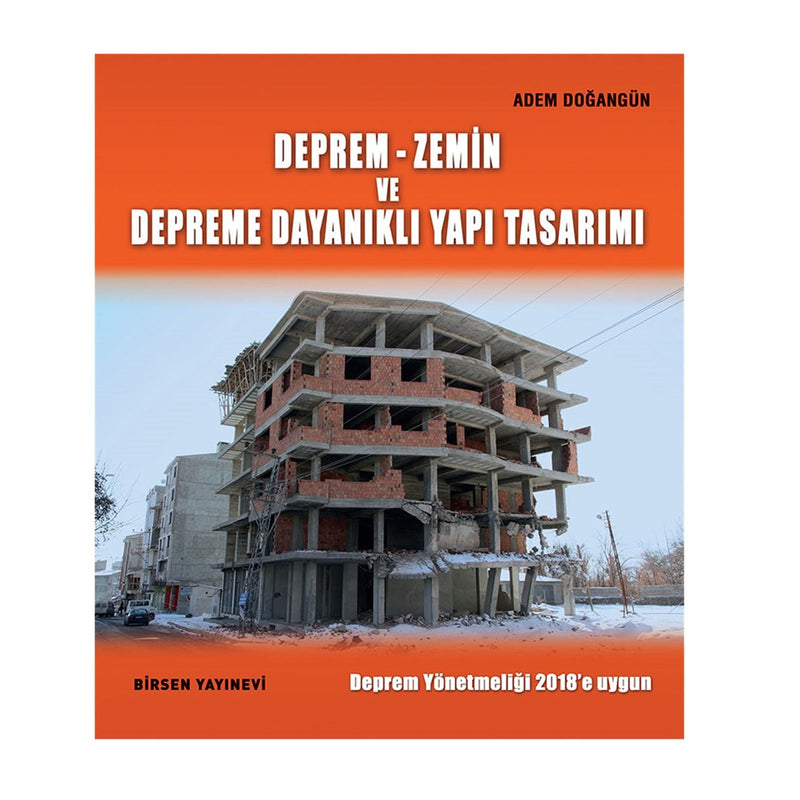
Earthquake-Soil and Earthquake-Resistant Building Design
3,230.00TL
3,400.00TL
%5 İndirimli
Yazar: Adem Doğangün
Brand: Birsen Yayınevi
Basım Tarihi: 2021
Basım Dili:
Sayfa Sayısı: 540Boyut: 21.0 x 24.0 cm
Out Of Stock
9789755117102
Product Description
Radical changes have been made to the Earthquake Regulation, which came into force in 2019. For this reason, academics and technical personnel involved in structural design have found it necessary to update their knowledge. It has also made it mandatory to update the software used in structural analyses. However, since the regulation concerns many types of buildings and has been almost completely renewed, grasping and perfectly presenting all aspects is as difficult as impossible for me. Nevertheless, this book has been prepared with the hope that it might contribute, aiming to present the fundamental topics for the earthquake-resistant design of reinforced concrete structures to the engineering and architectural communities. Previously, we had the opportunity to compile the notes we taught our students in classes and the seminar presentations we gave to our colleagues into a book during the KORONA days. Personally, this book will remind me of the Corona days in the future.
Our book, "Calculation and Design of Reinforced Concrete Structures," has reached its seventeenth edition with the favor of the engineering community. In this book, the scope of earthquake-soil-structure has been expanded to include other disciplines. The topic of earthquakes, which is common to geology and geophysics engineers, has been tried to be explained from the perspective of a civil engineer. The topic of soil, which closely concerns those working in the geotechnical branch of civil engineering and geoscientists, has been examined by an academic working in the structural discipline. The intention here is solely to explain how the parameters used in design are determined and what they signify in terms of behavior, from the perspective of a structural engineer. I would like to state that I would be grateful if any errors or deficiencies found in the book regarding these topics are brought to my attention.
I respectfully commemorate all my professors who contributed to my education, and I thank Assoc. Prof. Hakan T. TÜRKER and Assist. Prof. Serkan SAĞIROĞLU, with whom I still work in the same department and benefit from their views.
Every academic inevitably has students with whom they work and progress. The knowledge and experience I gained from the work of my graduate students have significantly contributed to the increase in my knowledge in this field. In this regard, I would like to express my thanks to all my graduate students. Many of my students also contributed during the process of creating this book. However, I especially thank all my colleagues and students, especially M. Ömer Timurağaoğlu, Fikrat Elmahdi, and Waheed Rasekh, for their unwavering support and contributions in the preparation of the book.
I tried to dedicate my time outside of scientific studies and essential work to my family. However, I am still aware that I sometimes encroached upon their time. The preparation of this book required a strenuous effort that covered almost the entirety of the Corona days. During this period, I would like to express my gratitude to my wife Şule and my son Fatih, who patiently supported me and provided the best environment for my work, to my daughters Ayşegül and Esra, who provided moral support from afar, and to my beloved grandchildren Zeynep and Ahmet Emir.
I sincerely hope that this book will be helpful to students of civil, geological, and geophysical engineering departments, as well as architecture departments, who are interested in earthquakes, and to graduates working in practice.
Adem DOĞANGÜN
January 2021
Our book, "Calculation and Design of Reinforced Concrete Structures," has reached its seventeenth edition with the favor of the engineering community. In this book, the scope of earthquake-soil-structure has been expanded to include other disciplines. The topic of earthquakes, which is common to geology and geophysics engineers, has been tried to be explained from the perspective of a civil engineer. The topic of soil, which closely concerns those working in the geotechnical branch of civil engineering and geoscientists, has been examined by an academic working in the structural discipline. The intention here is solely to explain how the parameters used in design are determined and what they signify in terms of behavior, from the perspective of a structural engineer. I would like to state that I would be grateful if any errors or deficiencies found in the book regarding these topics are brought to my attention.
I respectfully commemorate all my professors who contributed to my education, and I thank Assoc. Prof. Hakan T. TÜRKER and Assist. Prof. Serkan SAĞIROĞLU, with whom I still work in the same department and benefit from their views.
Every academic inevitably has students with whom they work and progress. The knowledge and experience I gained from the work of my graduate students have significantly contributed to the increase in my knowledge in this field. In this regard, I would like to express my thanks to all my graduate students. Many of my students also contributed during the process of creating this book. However, I especially thank all my colleagues and students, especially M. Ömer Timurağaoğlu, Fikrat Elmahdi, and Waheed Rasekh, for their unwavering support and contributions in the preparation of the book.
I tried to dedicate my time outside of scientific studies and essential work to my family. However, I am still aware that I sometimes encroached upon their time. The preparation of this book required a strenuous effort that covered almost the entirety of the Corona days. During this period, I would like to express my gratitude to my wife Şule and my son Fatih, who patiently supported me and provided the best environment for my work, to my daughters Ayşegül and Esra, who provided moral support from afar, and to my beloved grandchildren Zeynep and Ahmet Emir.
I sincerely hope that this book will be helpful to students of civil, geological, and geophysical engineering departments, as well as architecture departments, who are interested in earthquakes, and to graduates working in practice.
Adem DOĞANGÜN
January 2021
