
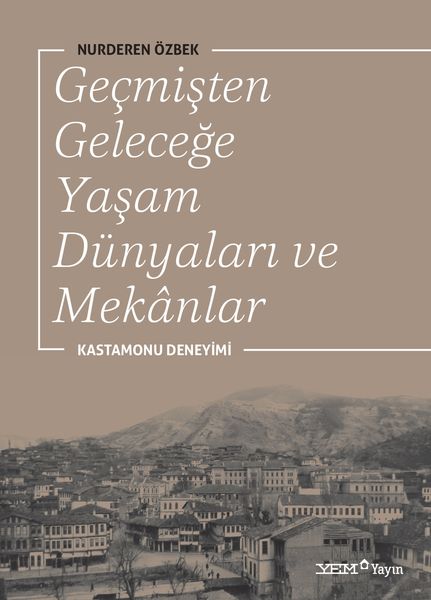
Life Worlds and Spaces: From Past to Future
490.00TL
700.00TL
%30 İndirimli
Yazar: Nurderen Özbek
Brand: YEM Yayın
Basım Tarihi: Ekim 2019
Basım Dili:
Sayfa Sayısı: 224Boyut: 16.5x23 cm
Out Of Stock
9786058043473
Share:
Product Description
YEM Yayın has published Dr. Nurderen Özbek’s book titled Life Worlds and Spaces from Past to Future – The Kastamonu Experience, in which she approaches architecture as “a phenomenon that reflects the traces, values, social and cultural memory of human existence; and encompasses humans with their past, memories, and future.”
Nureren Özbek, whose work meticulously uncovers the impact of daily life traces on the formation of settlement textures with their streets, gardens, and houses, aims to outline a sustainability that preserves the traces of the past without hindering contemporary life, rather than merely protecting the texture as a physical shell. She describes the process as follows:
“On this journey I embarked upon to discover Kastamonu, my hometown, from a different perspective, the feelings evoked by the disappearances in the traditional texture led me to the realization that these feelings could not merely be attributed to the loss of the physical structure of “street-garden-house”; in fact, the lives within them shaped the texture and elevated it beyond the ordinary, directing me towards human existence, memory, and culture. The living environments shaped by the unique consciousness structures and values of different societies, communities, and individuals revealed the different layers, diversity, and harmony within this diversity that constitute the texture; valuable conversations during oral history studies revived the city’s fading memory and showcased the changes in the urban texture. While experiencing the city through its dimension of life, perceiving the settlement texture through distant and near observations allowed me to identify characteristic elements specific to the place.”
The opinions of the doyens of Turkish architectural education, who have closely followed and observed the study from its inception, regarding the book are as follows:
“…..Intervening in a place also means intervening in people, established lives, memories, and certain accumulations. This shows that the discourse of today's architecture can no longer be limited to the object of architecture. It is essential to conceptualize and analyze architecture as inherent to people and lives, as much as to the place. We urgently need the construction of such knowledge. It is clear that knowledge of a kind of open-endedness and spontaneity not present in the existing knowledge of architecture, rather than existing forever and stopping time, but including the dimensions of existence-sustainability-perhaps extinction, and change with life, can contribute to the existing knowledge of architecture.
In this sense, Nurderen Özbek has pursued a very valuable research, but this is also a very challenging path. It is more a quest for how to approach the values we possess, rather than searching for a recipe of what to do. It is an important study in terms of opening the door to new quests that are not hasty and rent-driven, but patient, careful, extended over time, and aware of how different lives build space.”
-Prof. Dr. Belkıs Uluoğlu
“In the work, where the subject is visualized using numerous drawings and photographs, examples from different historical cities of the world are provided, and at the same time, settlement examples from Anatolia spanning from antiquity to the present day are emphasized. Subsequently, in the study that turns its face to Kastamonu, this city, whose history dates back thousands of years, is comprehensively revived with accompanying drawings and pictures. The author also incorporates literature into her style when she deems it necessary, thus creating a work that communicates with other scientific disciplines; while examining the quietly disappearing wooden buildings and other historical structures of cities, she also draws upon human sciences such as sociology, psychology, and philosophy. After describing living spaces, she seeks solutions for this depletion and destruction in cities, and questions what needs to be done.”
-Prof. Dr. Sakine Eruz
“Works of art are tangible reflections of the culture a society has created throughout its past life. Architecture, on the other hand, is defined as the field where cultural accumulation is most concretely embodied and manifested within artistic activities. A painting or a sculpture can reach a limited number of people. However, architectural products can reach all segments and individuals of society; they can be perceived and experienced by everyone.
Architecture is not merely about producing singular structures. Buildings with different functions come together through voids such as streets, gardens, and squares to form settlements – cities. Therefore, the city is where everything human, "culture," can be perceived most widely in all its dimensions. Multi-layeredness and diversity are found in almost every city. This diversity must absolutely be preserved and sustained.
In this context, in her book "Life Worlds and Spaces from Past to Future," Dr. Nurderen Özbek states that the concept of "conservation" does not only mean protecting physical structures, spaces, and productions, but also protecting life data. In her book, where she addresses the concepts of "structure-life coexistence, documentation of the life dimension, and the protection of urban memory in all its dimensions," Özbek successfully demonstrates that architectural-cultural heritage is not only composed of tangible structures, that there are intangible values behind what is visible, using Kastamonu, perhaps one of the most suitable cities for such research, as a laboratory.”
Prof. Dr. Kutgün Eyüpgiller
CONTENTS
06 Foreword
08 Presentation
10 Author’s Foreword
12 Introduction
18 Home and Life Values in Sustainability
20 Traces of Life in Settlement Design
22 Human Existence
23 Memory
25 Culture
27 Anatolian Housing Settlements in the Context of Life
27 Cultural Stratification and the Phenomenon of Settlement
32 The Impact of Vital Transformation on Housing Settlements and New Settlement Quests
40 Studies Conducted to Ensure the Sustainability of Urban Housing Settlements
41 Conceptual/Theoretical Approaches
41 Conservation Approaches
42 Sustainability Approaches
44 Methods Applied in the Context of Sustainability / Conservation of Traditional Housing Settlements
47 Legal Regulations Regarding the Preservation of Values Pertaining to Human Existence that Constitute Civil Architecture and Civil Life
47 International Organizations and Statutes
49 Laws, Organizations, and Studies Applied in Turkey
50 Examples of Cities That Can Sustain Life Values with Their Original Texture
50 Bath, England
54 Asmara, Eritrea
60 Bologna, Italy
68 A Method Based on the Concept of “Life World” and Housing Settlements
74 Street
76 Garden
78 House
80 Evaluation of the Method Through the Kastamonu Example
82 Kastamonu
92 Factors Affecting the Design of the City’s Housing Settlements
94 Kastamonu from a Time Perspective
102 Social Structure
110 Administrative Decisions
115 Conservation Efforts in the City
120 Analysis of Kastamonu’s Traditional Housing Settlements Through Four Streets
125 Saray Cami Street-Yıldırım Street-İzbe Street Line
145 Kırkçeşme Avenue
160 Baba Street
177 Kuleli Street
188 Findings
193 Kastamonu Sustainability Analysis Results and Recommendations
200 Conclusion
206 References
213 Appendices
Nureren Özbek, whose work meticulously uncovers the impact of daily life traces on the formation of settlement textures with their streets, gardens, and houses, aims to outline a sustainability that preserves the traces of the past without hindering contemporary life, rather than merely protecting the texture as a physical shell. She describes the process as follows:
“On this journey I embarked upon to discover Kastamonu, my hometown, from a different perspective, the feelings evoked by the disappearances in the traditional texture led me to the realization that these feelings could not merely be attributed to the loss of the physical structure of “street-garden-house”; in fact, the lives within them shaped the texture and elevated it beyond the ordinary, directing me towards human existence, memory, and culture. The living environments shaped by the unique consciousness structures and values of different societies, communities, and individuals revealed the different layers, diversity, and harmony within this diversity that constitute the texture; valuable conversations during oral history studies revived the city’s fading memory and showcased the changes in the urban texture. While experiencing the city through its dimension of life, perceiving the settlement texture through distant and near observations allowed me to identify characteristic elements specific to the place.”
The opinions of the doyens of Turkish architectural education, who have closely followed and observed the study from its inception, regarding the book are as follows:
“…..Intervening in a place also means intervening in people, established lives, memories, and certain accumulations. This shows that the discourse of today's architecture can no longer be limited to the object of architecture. It is essential to conceptualize and analyze architecture as inherent to people and lives, as much as to the place. We urgently need the construction of such knowledge. It is clear that knowledge of a kind of open-endedness and spontaneity not present in the existing knowledge of architecture, rather than existing forever and stopping time, but including the dimensions of existence-sustainability-perhaps extinction, and change with life, can contribute to the existing knowledge of architecture.
In this sense, Nurderen Özbek has pursued a very valuable research, but this is also a very challenging path. It is more a quest for how to approach the values we possess, rather than searching for a recipe of what to do. It is an important study in terms of opening the door to new quests that are not hasty and rent-driven, but patient, careful, extended over time, and aware of how different lives build space.”
-Prof. Dr. Belkıs Uluoğlu
“In the work, where the subject is visualized using numerous drawings and photographs, examples from different historical cities of the world are provided, and at the same time, settlement examples from Anatolia spanning from antiquity to the present day are emphasized. Subsequently, in the study that turns its face to Kastamonu, this city, whose history dates back thousands of years, is comprehensively revived with accompanying drawings and pictures. The author also incorporates literature into her style when she deems it necessary, thus creating a work that communicates with other scientific disciplines; while examining the quietly disappearing wooden buildings and other historical structures of cities, she also draws upon human sciences such as sociology, psychology, and philosophy. After describing living spaces, she seeks solutions for this depletion and destruction in cities, and questions what needs to be done.”
-Prof. Dr. Sakine Eruz
“Works of art are tangible reflections of the culture a society has created throughout its past life. Architecture, on the other hand, is defined as the field where cultural accumulation is most concretely embodied and manifested within artistic activities. A painting or a sculpture can reach a limited number of people. However, architectural products can reach all segments and individuals of society; they can be perceived and experienced by everyone.
Architecture is not merely about producing singular structures. Buildings with different functions come together through voids such as streets, gardens, and squares to form settlements – cities. Therefore, the city is where everything human, "culture," can be perceived most widely in all its dimensions. Multi-layeredness and diversity are found in almost every city. This diversity must absolutely be preserved and sustained.
In this context, in her book "Life Worlds and Spaces from Past to Future," Dr. Nurderen Özbek states that the concept of "conservation" does not only mean protecting physical structures, spaces, and productions, but also protecting life data. In her book, where she addresses the concepts of "structure-life coexistence, documentation of the life dimension, and the protection of urban memory in all its dimensions," Özbek successfully demonstrates that architectural-cultural heritage is not only composed of tangible structures, that there are intangible values behind what is visible, using Kastamonu, perhaps one of the most suitable cities for such research, as a laboratory.”
Prof. Dr. Kutgün Eyüpgiller
CONTENTS
06 Foreword
08 Presentation
10 Author’s Foreword
12 Introduction
18 Home and Life Values in Sustainability
20 Traces of Life in Settlement Design
22 Human Existence
23 Memory
25 Culture
27 Anatolian Housing Settlements in the Context of Life
27 Cultural Stratification and the Phenomenon of Settlement
32 The Impact of Vital Transformation on Housing Settlements and New Settlement Quests
40 Studies Conducted to Ensure the Sustainability of Urban Housing Settlements
41 Conceptual/Theoretical Approaches
41 Conservation Approaches
42 Sustainability Approaches
44 Methods Applied in the Context of Sustainability / Conservation of Traditional Housing Settlements
47 Legal Regulations Regarding the Preservation of Values Pertaining to Human Existence that Constitute Civil Architecture and Civil Life
47 International Organizations and Statutes
49 Laws, Organizations, and Studies Applied in Turkey
50 Examples of Cities That Can Sustain Life Values with Their Original Texture
50 Bath, England
54 Asmara, Eritrea
60 Bologna, Italy
68 A Method Based on the Concept of “Life World” and Housing Settlements
74 Street
76 Garden
78 House
80 Evaluation of the Method Through the Kastamonu Example
82 Kastamonu
92 Factors Affecting the Design of the City’s Housing Settlements
94 Kastamonu from a Time Perspective
102 Social Structure
110 Administrative Decisions
115 Conservation Efforts in the City
120 Analysis of Kastamonu’s Traditional Housing Settlements Through Four Streets
125 Saray Cami Street-Yıldırım Street-İzbe Street Line
145 Kırkçeşme Avenue
160 Baba Street
177 Kuleli Street
188 Findings
193 Kastamonu Sustainability Analysis Results and Recommendations
200 Conclusion
206 References
213 Appendices
