
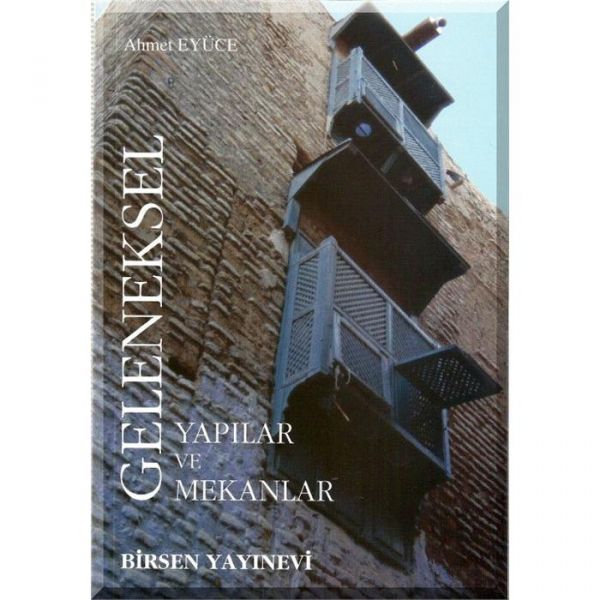
Traditional Buildings and Spaces
800.00TL
Yazar: Ahmet Eyüce
Brand: Birsen Yayınevi
Basım Tarihi: 2005
Basım Dili:
Sayfa Sayısı: 116Boyut: 13.5 x 20
Out Of Stock
9789755114309
Product Description
FOREWORD
Traditional structures and the settlements they formed have been an area of interest and study for me since my student years. The first encounter, which began with the field study of the Hisar neighborhood in Ankara-Kaleiçi as part of the Introduction to Architecture course in the year I started my architecture education at METU, was enriched by visits to settlements in the Cappadocia region, Çankırı, and Kastamonı. I began to look at traditional settlements and structures and their characteristics with increasing interest. Trips I took with groups of architecture school friends to Söke, Milas, Güllük, Bodrum, etc., in the environment where I was born and raised in İzmir, provided me with important visual acquisitions, also influenced by the architectural education I was receiving.
In the years following my graduation from architecture school, at the E.Ü. School of Architecture where I worked as an assistant in İzmir, 'Traditional Architecture Research' was within the interest of many faculty members. Among these, Prof. Dr. Doğan Tuna and Lecturer Yılmaz Tosun held significant places. Within the possibilities offered by the rich architectural heritage of the Aegean, Professor Doğan conducted survey studies with his students, while Yılmaz Tosun, who published his book Kula Houses with his own means, was working on his doctoral thesis on traditional settlements. I assisted both professors, along with the students, in both field and other studies. The work environment in İzmir, which focused on determinations and descriptions rather than the theoretically-heavy discussions that were my area of interest, shed important light on understanding regional architectures and provided me with invaluable visual riches.
During my master's degree in Urban Design, I was part of a group that focused on studies related to the city of Muğla, and these acquisitions proved very useful to me in later years.
Between 1981-88, I worked as a faculty member at King Abdulaziz University in Jeddah, Saudi Arabia. During my tenure, I had the opportunity to visit and examine traditional architectures in many parts of the country, especially in the Hejaz region. Within the framework of a research project I received from the KAAU Research Institute, I conducted studies in the cities of Jeddah, Mecca, Medina, and Taif; I photographed traditional architectures with special permission granted by the university in Saudi Arabia, where photography was forbidden. In the early eighties, the traditional urban fabrics of the Hejaz cities had not yet deteriorated. Although there were occasional destructions, the large-scale destructions observed first in Medina and then in Taif had not yet begun. In subsequent years, destructions accelerated, and with the exception of a small part of Jeddah, the traditional fabrics of the Hejaz cities were completely obliterated. Almost all of the structures included in this book have now been destroyed. During my time in Hejaz, I traveled to the USA, Singapore, and Malaysia, as well as many European countries, and conducted research during these trips. The main importance of my years in Hejaz for my career is that I was able to find the time and opportunities to conduct theoretical research in addition to gaining information on the subject.
I made numerous presentations at scientific meetings I attended both at home and abroad, and more importantly, I had the opportunity to meet local and foreign experts in traditional architecture studies. In the architecture schools where I served as a faculty member, I initiated traditional architecture courses and research at undergraduate and graduate levels, and supervised master's and doctoral theses on this subject. The emergence of this book is the result of the observations, acquisitions, and studies listed above. Furthermore, I extend my endless thanks to everyone who contributed to the realization of this work and its transformation into a book. First among these is my wife, Assoc. Prof. Dr. Özen Eyüce. Hikmet Sivri Gökmen, Kıvılcım Keskiner, Yasemin Sayar, Özlem Erdoğdu Erkarslan, Emre Ergül, Turgut Çıkış, Deniz Özkut, and Can Kaya assisted in field studies and survey drawings, and I owe them my gratitude.
TABLE OF CONTENTS
Research Approaches
Architectural Space
Space Boundaries and Delimiters
Space Arrangement and Building Shaping Processes in Traditional Architectures
Principles of Space Arrangement
Traditional Turkish House
Traditional Malay Houses
Traditional Chinese Houses in Malaysia
Traditional Hejaz Houses
Changes in Traditional Architectures
Evolution of Traditional Housing
Courtyard House
Beginning and Development Process of the Courtyard House
Expansions
Traditional Turkish House
Traditional Malay Houses
Traditional Hejaz Houses
Changes Other Than Expansion
Transformations
Determinants and Influencers in the Formation Processes of Traditional Architectures
Bibliography
