
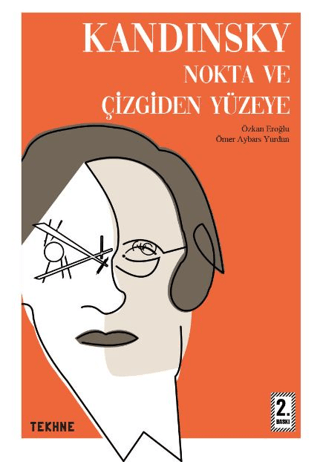
Kandinsky: From Point and Line to Plane
Yazar: Ömer Aybars Yurdun, Özkan Eroğlu
Brand: Tekhne Yayınları
Basım Tarihi: Eylül 2017
Basım Dili:
Sayfa Sayısı: 136Boyut: 13.5 x 19.5 cm
In stock
9786058413368
Product Description
After studying Wassily Kandinsky's "Über das Geistige in der Kunst" (Concerning the Spiritual in Art), published between 1911 and 1912, which explores the spiritual-content side of art, we wanted to delve into his "Punkt und Linie zu Fläche" (Point and Line to Plane), first published in 1923, which evaluates the material-form side of art, and thus this book came into being.
Kandinsky's most general and fundamental aim, especially in his theoretical works, was to articulate the problem of perception correctly and to find a way to solve it. In "Point and Line to Plane," Kandinsky is a free mind who progresses by asking questions about problems and providing answers. He is aware of the value of correctly interpreting problems. In this book, he believes in the great benefits of asking fundamental questions correctly in the theory of perception. Moving from the importance of dualistic thinking in reaching true knowledge, he chooses to generate ideas by placing the definition of "line" next to "point." The synthesis he aims for in the end is called "plane." Throughout this research, he adheres to the idea, also believed by Steiner, that "whatever is to be the subject of our knowledge, we acquire it by experiencing it in the form of direct and individual experience."
In conclusion, Kandinsky's book predominantly focuses on the three fundamental plastic values of art and examines the relationships between these plastic values and various art forms, as well as the connections art establishes with certain positive sciences through these same plastic values. Consequently, Kandinsky presents an exemplary work on the science of art with this book.
