
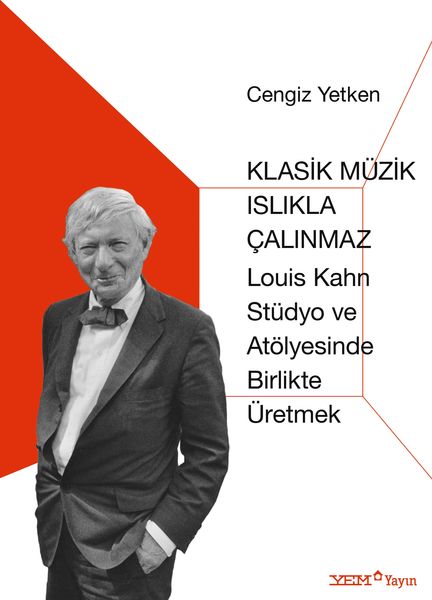
Classical Music Cannot Be Whistled
Yazar: Cengiz Yetken
Brand: YEM Yayın
Basım Tarihi: Haziran 2020
Basım Dili:
Sayfa Sayısı: 272Boyut: 16.5 x 23.0 cm
In stock
9786257008051
Product Description
Cengiz Yetken's book, which conveys his "learning and producing" experience with Louis I. Kahn, one of the leading figures of 20th-century architecture, with an original approach, was published by YEM Yayın.
“While working in the office, I had a habit of whistling Beethoven’s 5th Symphony. ‘Cengiz, please… You can’t whistle Beethoven!’ This was sudden and unexpected. Kahn continued: ‘You can’t whistle classical music, but you can hum it.’”
Cengiz Yetken is a figure who worked and produced with Louis Kahn, first as a student in Kahn's legendary graduate studio at the University of Pennsylvania School of Architecture, and then as a young colleague in his office at 1501 Walnut Street. This was a period when significant projects were underway in the relatively short but brilliant career of Kahn, a thinker, artist, and architectural guru, who was one of the important actors in 20th-century world architecture between the 1950s and 70s. As understood from the Yetken-Kahn dialogue carried in the book's title, this book is about the experiences of two architects who internalized architecture as a way of life, concerning the ordinary flow of life, the tonalities of music, the art of design, the experiences of a building beyond brick and mortar, its beginning, its formation, its life, its measurable and immeasurable values, and the essence of light and silence.
The book, edited by Müge Cengizkan, translated by Özlem Erdoğdu Erkarslan, and designed by Utku Lomlu, is meeting readers through YEM Yayın. Cengiz Yetken describes the book as follows:
“Throughout my professional life, both in architectural practice and as a professor in design education, I often encountered questions about Louis Kahn, perhaps one of the most distinguished architects of the 20th century. Many friends encouraged me to write about Kahn. Initially, I considered writing a series of letters to my children, conveying my experiences with Lou and why his buildings were so special. However, I later realized that I should convey these to students in architecture schools and to my colleagues in practice. This would be the best way to communicate the design sensibility ingrained in his buildings and the ideas that gave rise to them. Gradually, I understood that what I wrote could not remain merely memories, but would shed light on the act of design. This also became a personal journey that allowed me to rediscover my own understanding of design. This book does not aim to explain Kahn’s architectural approach or his views. These memories are what I learned from my time with Kahn, from his class, his office, his buildings, and from being in the profession for all these years. I am trying to answer a difficult question: What did I learn from Kahn?”
CONTENTS
FOREWORD
KAHN STUDIO AT PENN
1.A FOREIGN STUDENT
PHILADELPHIA
2. “ART IS THE LANGUAGE OF GOD”
MEETING
UNDER THE TREE
DESIRE / NEED
RICHARDS
STRUGGLE
AROUND THE TABLE
PAINTED LINES
SEEING THE PLACE
LIFE STORIES
MAKING MODELS
POETICISM
STRADIVARIUS
BELIEF
AROUND THE TABLE
PANEL
DON'T COPY KAHN
SYMPHONY
CORRIDOR
THE TRAVELED AND THE PASSED
ASKING
SOUND
INTERSECTIONS
FINAL JURY
3. “ARCHITECTURE HAS NO EXISTENCE”
PROJECT INTRODUCTION: FDR MEMORIAL
FOUNTAIN
AROUND THE TABLE
MOZART IN GREECE
WHO IS CENGIZ YETKEN?
Born in Ceyhan, Adana in 1940. He graduated from METU Faculty of Architecture with a bachelor's degree in 1963 and a master's degree in 1964. In 1965, he went to the University of Pennsylvania to pursue a master's degree in Louis Kahn's studio, graduating in 1966. He worked as a "project manager" at Louis Kahn's Office, where he started working during his studies, until 1968. In addition to his work at the office, he also served as a faculty member at the University of Pennsylvania, leading an architectural design studio between 1966 and 1968. In 1968, he returned to Turkey and taught architectural design at the METU Faculty of Architecture, his alma mater, until 1975. In 1975, he decided to return to the USA. He worked as a faculty member at Ball State University, School of Architecture and Planning until 1977, and at the University of Virginia until 1981. He decided to transition from academia to professional practice. Between 1981 and 1986, he worked as a senior architect at SOM Chicago. In 1984, he qualified to become a member of the American Institute of Architects (AIA). In 1986, he decided to open his own office, and until 1990, in his Oak Park office, he not only produced architectural designs but also designed industrial design objects and continued his film directing studies. Between 1987 and 1991, he taught as a visiting artist at the School of the Art Institute of Chicago. From 1990 to 2006, he had a long and productive career as a senior project architect at Perkins+Will Chicago. From 2006 to 2009, he served as an architectural design consultant for the same company. In addition to being a licensed architect in Illinois as an AIA member, he is also a member of the Chamber of Architects of Turkey and the Fulbright Education Commission. After his retirement in 2009, he continues his life by engaging in personal work at his homes in Chicago and Bodrum Demir Tatil Evleri.
