
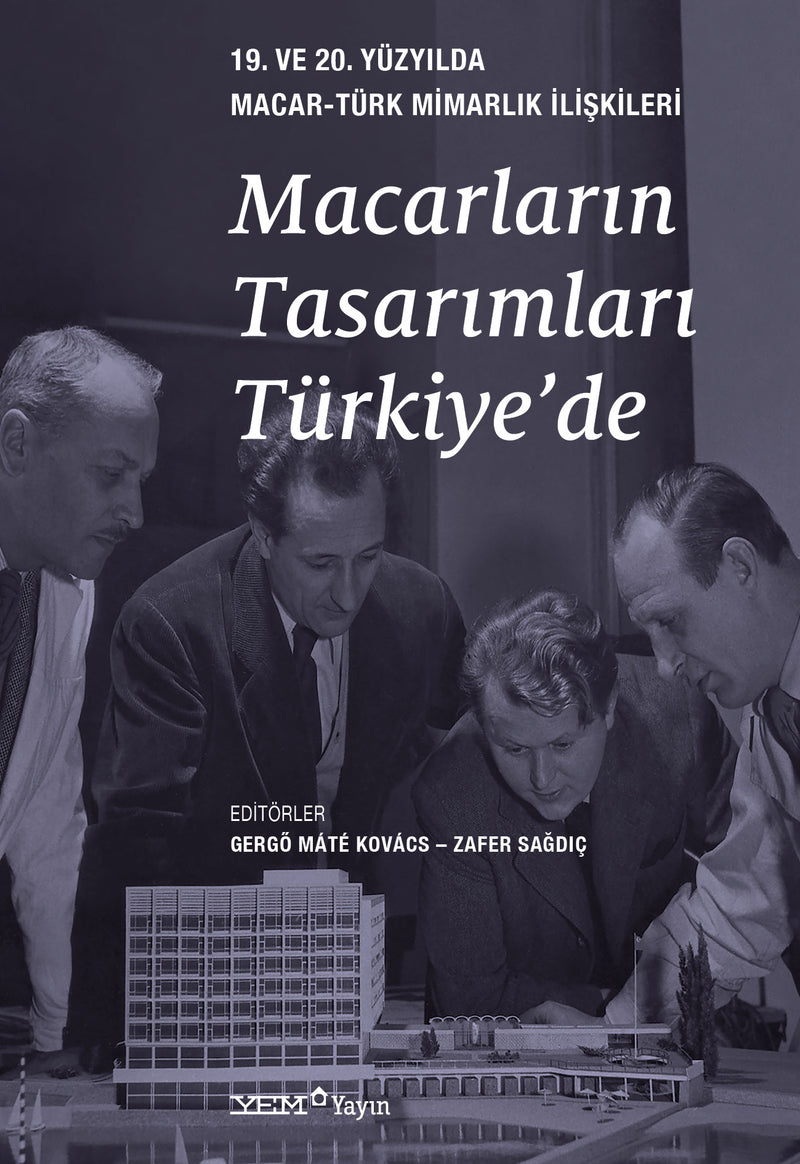


Hungarian Designs in Turkey – Hungarian-Turkish Architectural Relations in the 19th and 20th Centuries
Yazar: Mate Gergö Kovacs (editör), Zafer Sağdıç (editör)
Brand: YEM Yayın
Basım Tarihi: Haziran 2025
Basım Dili: ["Turkish"]
Sayfa Sayısı: 192Boyut: 16.5 x 24.0 cm
In stock
9786259710228
Product Description
"Hungarian Designs in Turkey," a book edited by Zafer Sağdıç and Mate Gergö Kovacs, and published by YEM Yayın, presents a new area of previously undiscovered common cultural ties between Turkey and Europe, especially focusing on Turkish-Hungarian architectural relations.
The book was published within the framework of the "2024 Hungarian-Turkish Cultural Year" in cooperation with the Hungarian Ministry of Foreign Affairs and Trade, the Gül Baba Heritage Foundation, Yıldız Technical University, Budapest University of Technology and Economics, the Liszt Institute – Hungarian Cultural Center, and the Turkish Architecture Research Center.
The architectural drawings, ideas, and architectural relationships presented in the book, which describe the process ranging from the orientalist presentation and use of Turkish architectural culture to the application of modern architectural principles, were prepared with the joint collaboration of expert Turkish and Hungarian researchers and had not been previously presented to the public in this format.
Prof. Dr. János Krähling, Head of the Department of Architectural History and Heritage Preservation at the Faculty of Architecture, Budapest University of Technology and Economics, shared his thoughts on the book:
"Following the weakening of the Ottoman Empire's presence in Europe, the architectural community's interest in Turkish architectural culture did not wane. During this period, an interest emerged, becoming increasingly prominent from the 17th century onwards, characterized by an openness to learning and applying the significant works of Guarini's Moorish architecture, particularly its structures. In this era, Baroque architecture demonstrated an open perspective towards other cultures, including Turkish architecture. The Austrian architect Johann Bernhard Fischer von Erlach, in his work 'Entwurff einer historischen Architektur,' published in 1721 and enriched with architectural drawings, presented some significant monuments from the Ottoman architectural heritage, demonstrating such openness on a theoretical level and including the Ottomans in the first universal history of architecture.
Among the monuments of Hungarian architecture, we can find monuments suitable for this process, such as the Turkish mosque located in the Palace Garden in the city of Tata, a significant example of Hungarian romantic historicism. The romantic evocation of orientalist forms initially characterized these relations. Later, architectural projects related to Turkey became part of professional public life within the scope of customary client, jury, design, and construction activities.
The architectural drawings in the book present the architectural connections between Hungary, German-speaking countries, and Italy, which were important former European partners of the Ottoman Empire.
From the late Ottoman period to the early Republican era, many Hungarian architects designed a series of spaces in Turkey that reflected the common European dimension, the knowledge they acquired at German universities, Hungarian design practice, and the needs of Turkish clients and practitioners. These spaces, even if they were not realized, can be considered a special projection of mutual interaction and knowledge transfer. Although this book primarily focuses on unrealized projects, it later describes the 'driving force' that can be perceived as a ripple effect based on a series of additional thought activities in Hungary. Károly Kós, who was a scholarship holder in Turkey, made the following statements in connection with Istanbul's urban architecture and public institutions: 'This is what the city is; this is not just any city. (...) I believe that this work cannot be done by a foreigner; it must be done by Turkish architectural science and art...'"
