
 Yeni Baskı


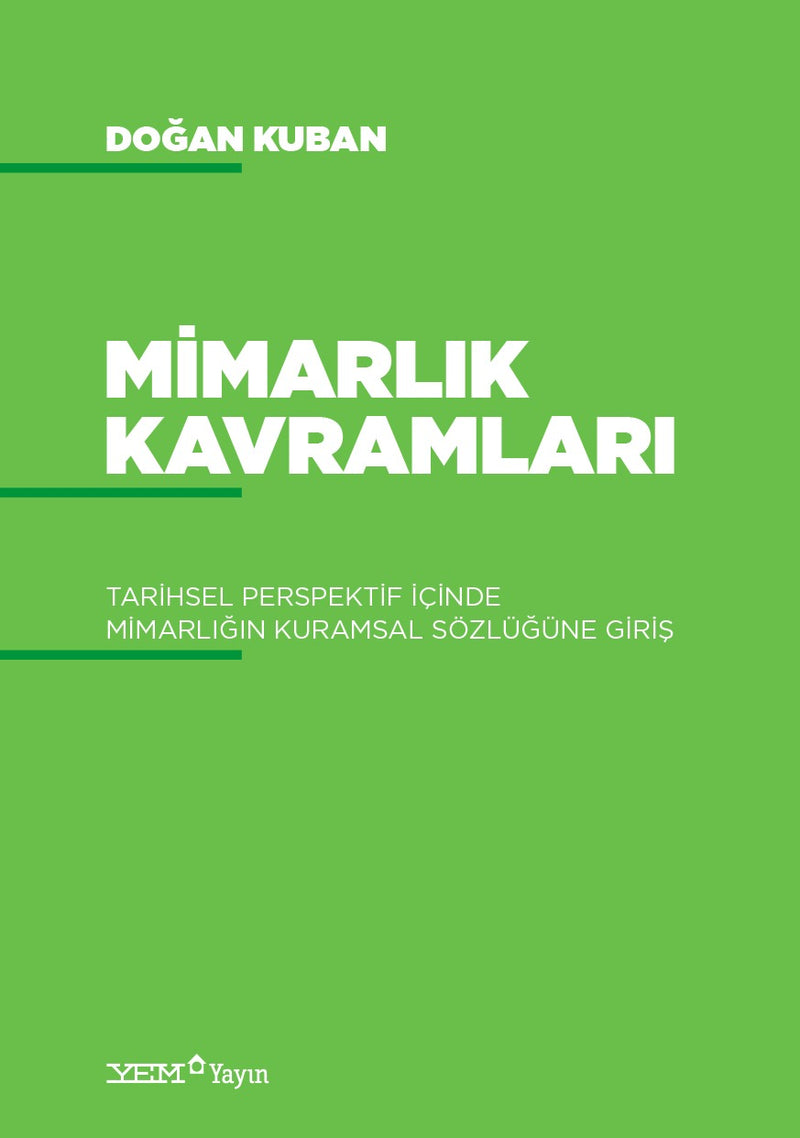
Architectural Concepts - 19th Edition
Yazar: Doğan Kuban,
Brand: YEM Yayın
Basım Tarihi: Nisan 2026
Basım Dili: ["Turkish"]
Sayfa Sayısı: 114Boyut: 14x21 cm
In stock
9786058136663
Product Description
YEM Yayın, which publishes books on topics such as architecture, interior design, design, engineering, urban planning, urbanization, industrial product design, landscape design, archaeology, culture, and art, has released the 19th edition of its book titled Mimarlık Kavramları (Architectural Concepts).
“The process of acquiring knowledge passes through theoretical teaching and printed paper. When it is accepted that the best person to teach architecture (except in special cases) should be an architect, the necessity for the architect to have the ability to express the act of building verbally, either to explain themselves or to understand what their colleagues are saying, arises. I hope this small book can, to some extent, show aspiring architects ways to articulate their work.”
DOĞAN KUBAN
Mimarlık Kavramları, which aims to correctly define architectural activity at a general and conceptual level, especially for those new to architecture and design education, comprehensively evaluates the boundaries of the objective conditions of building production, societal organization, the construction process, building form, and the relationships between individuals and society within a theoretical framework.
In his book Mimarlık Kavramları, which was initially prepared for introductory architectural history courses but was developed in subsequent editions to become one of the fundamental reference sources for architectural education in Turkey, Doğan Kuban gradually examines the emergence and development of basic concepts, which can be called the ABCs of architecture, within the history of architecture.
The book defines all components of architecture, from building materials and techniques such as stone, soil, wood, and mortar to structural elements like columns, arches, vaults, and domes; its relationships with art, aesthetics, cities, and society are examined in detail.
