
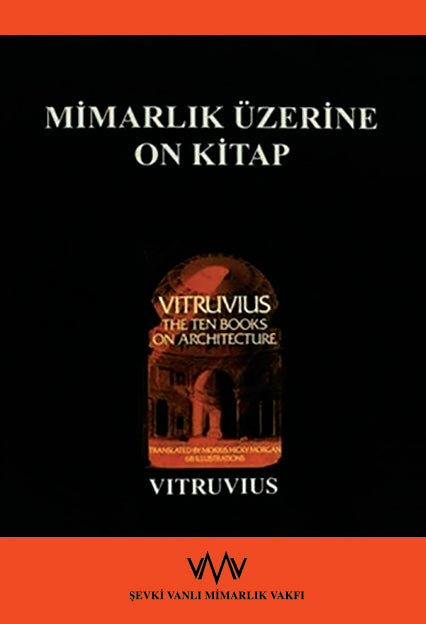
Ten Books on Architecture
Yazar: Vitruvius
Brand: Şevki Vanlı Mimarlık Vakfı Yayınları
Basım Tarihi: 2021
Basım Dili:
Sayfa Sayısı: 236Boyut: 15.5 x 22.0 cm
Out Of Stock
9789757722038
Product Description
De Architectura, penned by the Roman architect-engineer Vitruvius, is the only scientific work on architecture and engineering from antiquity to have survived to the present day, making it one of the foremost works of architectural art. The universal importance of the book and its intellectual structure have elevated it beyond being the property of a single culture, transforming it into a heritage of all civilized people within the world classics. The most significant feature of this work, consisting of ten books or, more precisely, ten chapters, is that it is a kind of summary of many Greek and a few Roman theoretical and technical publications written before it but subsequently lost; it also synthesizes the building traditions of its time with Vitruvius' own experiences to form a body of knowledge.
Lale Özgenel, who wrote a preface for Ten Books on Architecture, translated into Turkish by Suna Güven, alongside Albert A. Howard, Şevki Vanlı, Fikret K. Yeğül, and Adnan Aksu, states:
"...In De Architectura, written as a guide book consisting of ten chapters, two themes stand out. The first conveys that 'architecture encompasses all built and mechanical environments, is a very complex art, and is one of the most essential among the arts within humanity's social world'; the other states that proper professional practice requires the skillful synthesis of a wide variety of theoretical and professional knowledge..."
In Ten Books on Architecture, consisting of ten fundamental "chapters," each defined as a separate "book," the components of architecture and engineering are discussed in great detail, from material to method: the education of the architect, the fundamental principles of architecture, city walls, sites for public buildings, the origin of housing, brick, sand, lime, stone, timber, methods of wall construction, the Ionic order, the Tuscan temple, the Doric order, decorations, foundations, substructures, temple, altar, Greek theater, forum, basilica, bath, portico, vault, colors, farmhouse, experiments for good water, aqueduct, cistern, sundial, water clock, lifting machine, water wheel, water mill, defensive measures, catapults...
WHO IS VITRUVIUS?
Vitruvius, who is believed to have lived towards the end of the Roman Republican period (90-20 BC), is known to have been a military architect-engineer. His comprehensive and detailed book, De Architectura, is estimated to have been written around 25 BC after his retirement. Vitruvius, who is thought to have spent his youth serving as a military engineer-architect under Julius Caesar, dedicated his book to Augustus, the first Roman Emperor.
