
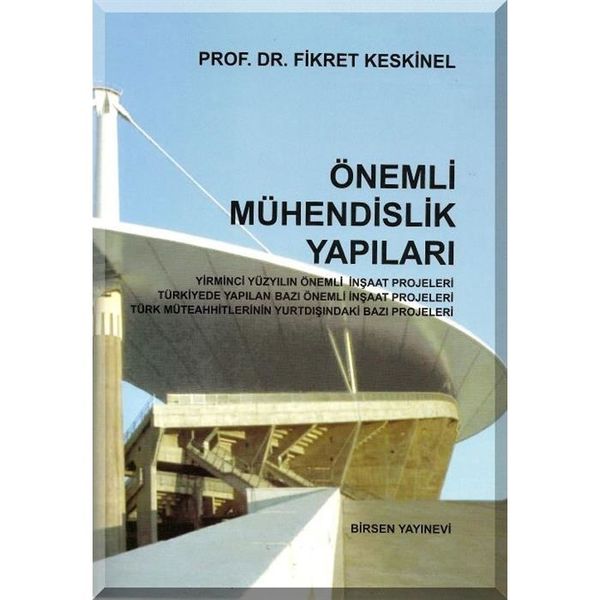
Key Engineering Structures
Yazar: Fikret Keskinel
Brand: Birsen Yayınevi
Basım Tarihi:
Basım Dili:
Sayfa Sayısı: 416Boyut: 16.0 x 24.0 cm
Out Of Stock
9789755114811
Product Description
There are two deadly mistakes that prevent the realization of large projects: 1. Not finishing 2. Not starting. The process of realizing a civil engineering project requires the regular and systematic execution of tasks falling under different areas of expertise and the appropriate use of resources. In the last twenty years, new tools/equipment/construction machinery and equipment have been introduced in the design and construction phases of a project, due to the rapid development of scientific research and technology. The increase in application has led to an accumulation of experience; larger-scale projects can now be completed in a shorter time and more economically. It is necessary to produce good solutions to problems that may arise during the realization of projects. Even experienced engineers struggle to find time from their mandatory work to research how similar problems were solved in the past, follow new developments, access this information instantly, and produce appropriate solutions to problems immediately.
There are many different factors that affect the realization process of a project; therefore, in addition to known and generally applied rules, experience, skill, and creativity are also required in the creation of a project. Experience is gained only by knowing, researching, and examining projects that have been done before. Civil engineering students and young civil engineers must develop their profession and themselves to overcome the problems they will encounter throughout their careers. It should not be forgotten that today there is a need for civil engineers who can communicate, adapt to changing project conditions, plan time/resources/costs, and produce high-quality/low-cost/specification-compliant projects. There is a large body of knowledge regarding civil engineering projects. Students new to the subject and engineers at all levels want to benefit from this information. However, for this, the information must be regularly and accessibly located in an information center or information bank. In our country, such formations are not sufficient in number and size; those that do exist also have accessibility issues.
In recent years, as a natural consequence of the increase in the number of civil engineering students and young engineers, questions such as what civil engineering is/what it does/how it is done, and what has been done/is being done/can be done have begun to be asked more frequently. This compilation, titled Important Engineering Structures, has been arranged to be useful for students seeking answers to these questions; for design/construction civil engineers and architects involved in the realization process of civil engineering projects; for young and experienced engineers who need post-professional training; and for all colleagues working in the construction sector.
The book provides brief general information about the project realization process; concise information about important engineering structures realized in the world, in our country, and within the scope of overseas contracting, is given in a certain systematic order. Undoubtedly, there are many important projects realized in every field of civil engineering in our country from 1923 to the present, and abroad from 1970 to the present. It is clear that it is not possible to give information about all these projects within the scope of the book, and it is very difficult, even impossible, to determine the order of importance by making a ranking according to some concrete criteria and making a selection accordingly. The importance of the projects, their contributions to the country and civil engineering, must be evaluated under the conditions of the years in which they were realized. In the selection of projects, in addition to concrete criteria such as being the first/largest/highest or distinctive features, access to information has been an important factor. Since there is not yet a sufficient civil engineering information center or information bank in our country, the information obtained from available and accessible sources for each project has been deemed sufficient; therefore, the information in all projects is not at the same level. In addition, in some projects, more detailed information has been provided due to their characteristics.
Care has been taken to present the information in the same order throughout the book. Project names are generally given as written in their contracts or in English, with the thought that it would be useful for those who may want to obtain additional information about the project from international sources. The book consists of four chapters and an appendix.
In the first chapter, basic concepts related to a project are briefly summarized to remind the necessary basic information for a better understanding of the civil engineering project realization process. In light of this information, it would be correct to say that projects considered successful today were realized by adhering as much as possible to these basic concepts, despite the limited economic and technical possibilities and difficult working conditions of their time. This chapter also provides brief general information on the global construction market and international contracting, with the aim of partly forecasting possible project demands in the near future and providing an idea for civil engineers and contractors to guide their forward-looking preparations.
In the second chapter, concise information about important construction projects of the twentieth century is given under the headings of largest construction investment projects, largest labor projects, buildings with important features, large-span bridges, large dams, longest tunnels, largest transported structures, construction disasters, some important ongoing projects, and futuristic dream projects. These projects, when evaluated considering the years they were realized, globally show the developmental stages of civil engineering.
In the third chapter, concise information about some important construction projects realized in Turkey is given under the main headings of long-term planning projects, buildings, culture/education/sports facilities, transportation structures, water structures, energy facilities, industrial facilities, and organized industrial zones. Before presenting information about projects in some clusters, especially for high-rise buildings, mass housing, energy, and industrial facilities, brief information explaining the general situation and approach in our country on these issues has been provided. In general, projects realized predominantly in the last 25-30 years have been included. When the projects are viewed globally, it is clearly seen that there has been great development in the field of Civil Engineering in our country, especially in the last 30 years.
In the fourth chapter, concise information about some important projects realized and ongoing abroad by Turkish contractors is presented under the main headings of buildings, culture/sports facilities, transportation structures, water structures, energy and petrochemical facilities, and industrial facilities. Brief information about investment companies that are owners of some Turkish investment projects included in these projects is given within the relevant project. In the APPENDIX section, concise information about the world's largest construction machinery and equipment is presented to emphasize the importance of construction machinery and equipment in project construction and to remind students and young civil engineers of this once again.
Numerous individuals and organizations have contributed directly and indirectly to the creation of this book. I owe a debt of gratitude to all my colleagues at every level of Enka, with whom I have worked in mutual interaction at every stage of many projects for many years, and who especially helped in gathering information for this work; to my dear friends, faculty members at Istanbul Technical University; to Enka Construction and Industry Inc., Ata Construction Inc., Aydıner Construction Inc., Baytur Construction Inc., Mesa Construction Inc., Yapı-Endüstri Merkezi Inc., Yapı Merkezi Inc., for allowing me to use their private archives; to Fatma Salman for helping shape the book; and to Birsen Publishing House for the care shown in printing.
Fikret Keskinel
Istanbul - April 2007
TABLE OF CONTENTS
GENERAL INFORMATION Basic Concepts
Project Concept Project Formation Stages Project Management Concept Project Management Team
Computer Usage in Project Management Applications Contract Terms Project Classification Typical Project C
ycles in Terms of Application Global Construction Market
Construction Expenditures by Country Some Thoughts on Market and Region New Investment Model Attempts International Contracting
Largest Global and International Contracting Companies International Contracting Companies by Region
IMPORTANT CONSTRUCTION PROJECTS OF THE TWENTIETH CENTURY
Largest Construction Investment Projects Projects with the Largest Workforce Buildings with Important Features.
Tallest Buildings Largest-Volume Building Largest Floor Area Building Buildings with the Largest Continuous Concrete Pour Largest Transported Structures y Large Span Bridges Longest Bridge Suspension bridges t Cable-Stayed Bridges
Cantilever Bridges Segmental Concrete Bridges Major Dams
Largest-Volume Earth/Rockfill Dams Dams with the Largest Reservoir Capacity Highest Dams Longest Tunnels Water Tunnels Railway Tunnels Road Tunnels - Construction Disasters
Construction Projects with the Highest Death Toll During Construction Major Construction Accidents Major Bridge and Roof Collapses Major Dam Collapses and Overflows Some Important Ongoing Projects Tall Buildings Some Interesting Reinforced Concrete Buildings Suspension Bridge Infrastructure Projects Longest Construction Duration Projects Future Dream Projects
SOME IMPORTANT CONSTRUCTION PROJECTS REALIZED IN TURKEY
Long-Term Planning Projects Buildings
Monumental Buildings High-Rise Buildings
Office Buildings and Shopping Centers Hotels and Holiday Villages Mass Housing Projects Culture / Education / Sports Facilities Cultural Facilities Educational Facilities Sports Facilities Transportation Structures
Bridges and Viaducts
Tunnels Highways
Airports
Bus Terminals
Urban Rail Systems Water Structures Dams Ports Water Tunnels
Dewatering / Intake / Conveyance / Water Distribution / Treatment / Sewerage Facilities Energy Facilities
Thermal Power Plants
Natural Gas Combined Cycle Power Plants Natural Gas / Oil Pipelines and Natural Gas Storage Facilities Industrial Facilities and Organized Industrial Zones Industrial Facilities Organized Industrial Zones
SOME IMPORTANT CONSTRUCTION PROJECTS REALIZED ABROAD BY TURKISH CONTRACTORS
Buildings Administrative / Government Buildings High-Rise Buildings 301 Office Buildings Shopping Malls.
Hotel Buildings Hospital Buildings Mass Housing Projects.
Culture / Sports Facilities
Cultural Facilities and Religious Structures Sports Facilities Transportation Structures
Bridges and Viaducts
Highways
Airports Urban Rail Systems
Water Structures Dams
Ports and Artificial Island Construction Water Intake / Conveyance / Water Distribution / Treatment Facilities Energy and Petrochemical Facilities
Netherlands - Natural Gas Combined Cycle Power Plant Project Tengiz-Kazakhstan and Azerbaijan Projects Sakhalin - CIS Projects Industrial Facilities
WORLD'S LARGEST CONSTRUCTION MACHINERY AND EQUIPMENT
