
Unlocking the Landscape
Yazar: Meltem Erdem Kaya (Editör)
Brand: YEM Yayın
Basım Tarihi: Mayıs 2022
Basım Dili:
Sayfa Sayısı: 224Boyut: 16.5 x 24.0 cm
Out Of Stock
9786257008518
Product Description
YEM Yayın's new book Opening the Landscape, edited by Meltem Erdem Kaya, has been published.
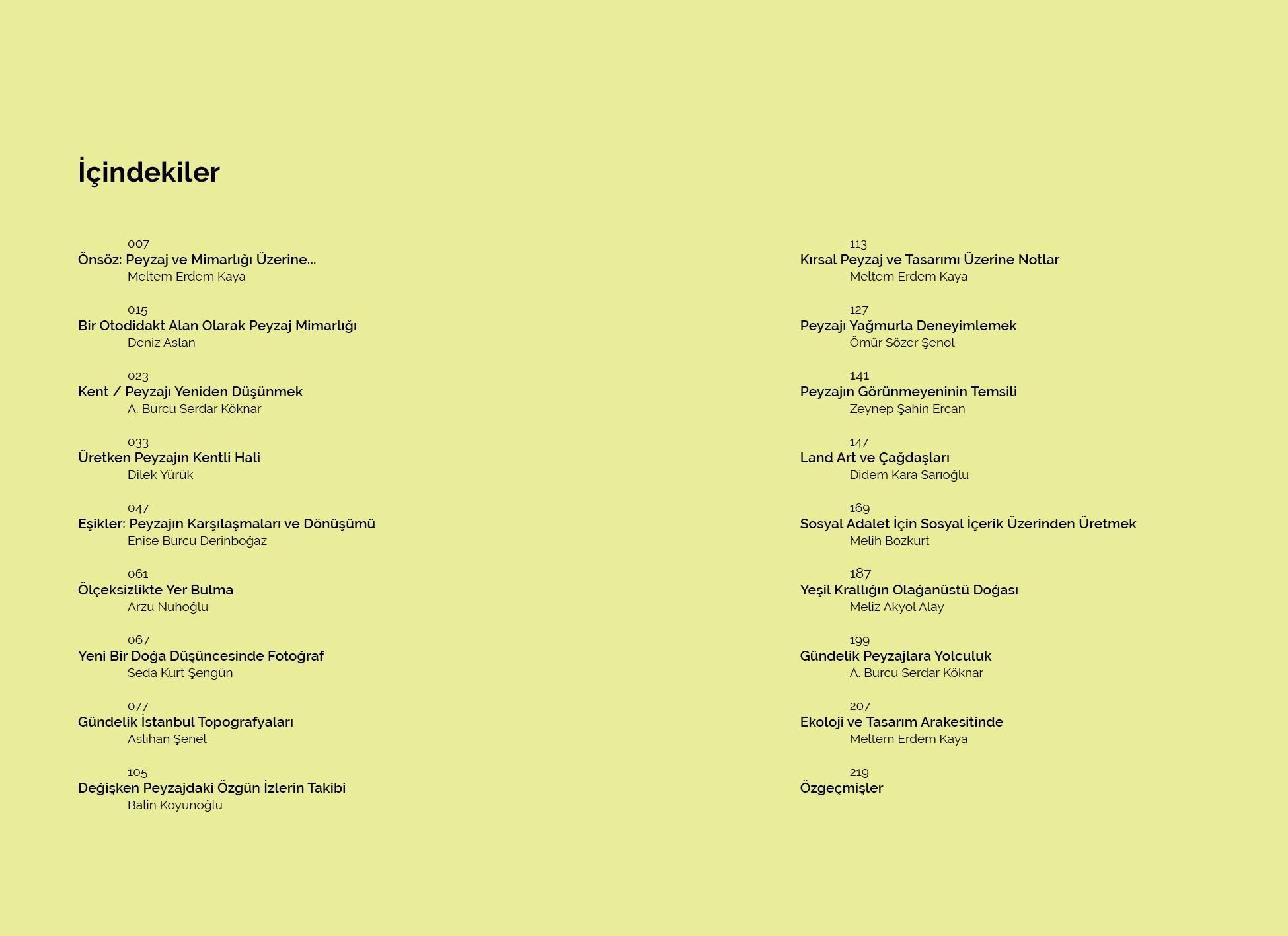
Opening the Landscape , penned by Deniz Aslan, A. Burcu Serdar Köknar, Dilek Yürük, Enise Burcu Derinboğaz, Arzu Nuhoğlu, Seda Kurt Şengün, Aslıhan Şenel, Balin Koyunoğlu, Meltem Erdem Kaya, Ömür Sözer Şenol, Zeynep Şahin Ercan, Didem Kara Sarıoğlu, Melih Bozkurt and Meliz Akyol Alay, presents the transformation, colors, politics, representation, publicness, ecology, traces, infrastructure, production, local aspects, and art of landscape from the perspectives of authors with diverse expertise.
The book re-explores the urban landscape, treating it as a narrative of rich, comprehensive, transforming, and experienced new landscapes produced by urban life, differing from conventional "urban landscape" components. Ecology, on the other hand, emphasizes the representation of a colorful world that breaks the green hegemony, which is the representative color of the landscape. Water is another topic discussed as a landscape element. Its management, existence, emerging textures, and life with water are discussed through the projects included in the book. It is a summary of the issue of city, transformation, and landscape, and its evaluation within this context. Undoubtedly, we are in a period where our critical stance towards practice and completed works should be prioritized.
The relationship between landscape and the city, updated through development projects under the title of transformation, perhaps indicates that the current commercial practice supports a questioning of interdisciplinary interaction. Another topic of the book is shaped through personal touches to decorative landscapes. The practice of learning from informal designs is questioned, in contrast to the project strategies of designers who sometimes question why public space designs are made and for whom they are produced, and who design everyday life spaces as "sterile" environments.
Landscape, as a common denominator that brings people together, is considered the most powerful social tool and purpose in creating social content. Landscape is taken as a comprehensive place and a package of applications for these areas, and the issue of design, as one of the systems heavily emphasized recently, gives voice to the designer's way of reading the rural. The rural, in its current form, is not considered a geography abstracted from design, understood with a high-level perspective, and only subject to planning, but rather a rich design area consisting of a multi-layered reading, containing unique textures, and possessing all kinds of spatial offerings. The plant world within the scope of the book queries its relations with design, and new roles, new works, and rich worlds are revealed within the 21st-century urban structure.
Opening the Landscape also covers Istanbul and its topographies. We read Istanbul, which we can consider a laboratory for urban and landscape research with its many values, this time with its old and new topographies. Within the scope of the dossier, landscape as an infrastructure, at the intersection of planning and design, is enriched with alternative performances over a certain range. Another topic, the trace of the landscape, presents a new interpretation of the current conditions of landscapes located within historical environments. The ties between landscape architecture and art are reinterpreted through land art and its contemporaries.
Landscape representation and methods are re-examined as a way of producing projects. As another form, the landscape is read, understood, and perceived through photographs, revealing a different experience of the landscape. Production is interpreted through the landscape, and new interpretations of the production landscapes of contemporary metropolises are discussed.
Opening the Landscape is a collective name for the representations of ideas brought together to reveal different areas of interest, different contents that landscape architecture deals with, represents, and articulates, within the "Landscape Dossier" published on the online platform of XXI Architecture, Design and Space Magazine, and has been expanded by the authors into a book to share its warmth with you, our readers.
