
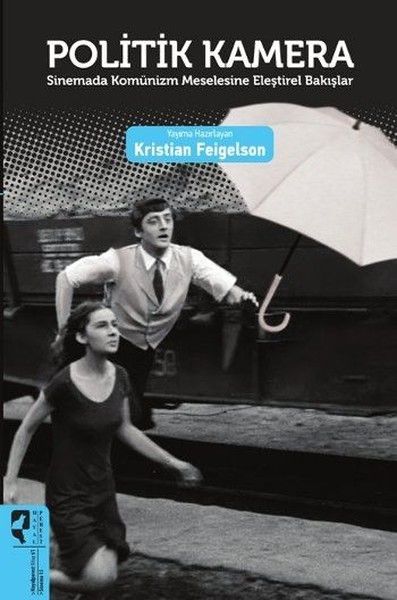
Political Camera
Yazar: Kristian Feigelson
Brand: Hayalperest Kitap
Basım Tarihi: Mart 2017
Basım Dili:
Sayfa Sayısı: 380Boyut: 15.0 x 23.0 cm
Out Of Stock
9786059452083
Product Description
When the words "politics" and "cinema" are placed side by side, the countries that first come to mind are usually Germany, the Soviet Union, and the United States, and the images are Hitler, Stalin, and Hollywood. The topic is frequently approached through communism, Soviet cinema, and Hollywood cinema as its counter-example. Offering an alternative to this habit, "Politik Kamera: Critical Perspectives on the Question of Communism in Cinema" expands its scope to avoid the intellectual impasses of evaluating communism in cinema solely from a Soviet-centric perspective. It includes the experiences of France, Italy, China, Cuba, Brazil, Georgia, Yugoslavia, Hungary, East Germany, Poland, Spain, and even the United States.
The book, edited by Kristian Feigelson, an academic and expert on East German and Soviet cinema, and with a foreword to the Turkish edition written by academic and director Mehmet Öztürk, contains critical texts penned by various country experts. These articles explain the socialist experience of the twentieth century, specifically the Stalin era and Stalinist cinema, in conjunction with political history, offering intriguing, new, and detailed information to the reader.
The first part of the two-part book examines the Soviet experience in all its aspects, while the second part features the thoughts of different nations and countries about Stalin. This allows the reader to feel both the power and fragility of cinema, cultural life, and art, which continue to assert themselves sometimes through humor, sometimes seriousness, sometimes history, and even symbols, in a world governed by political ambitions and sanctions.
This book allows readers interested in political cinema, curious about the ideas that shaped films associated with communism, and researching the opinions and attitudes of filmmakers, especially directors of the era, about the processes involved in film production, to also experience the pleasure of a cinematheque while reading the articles.
