
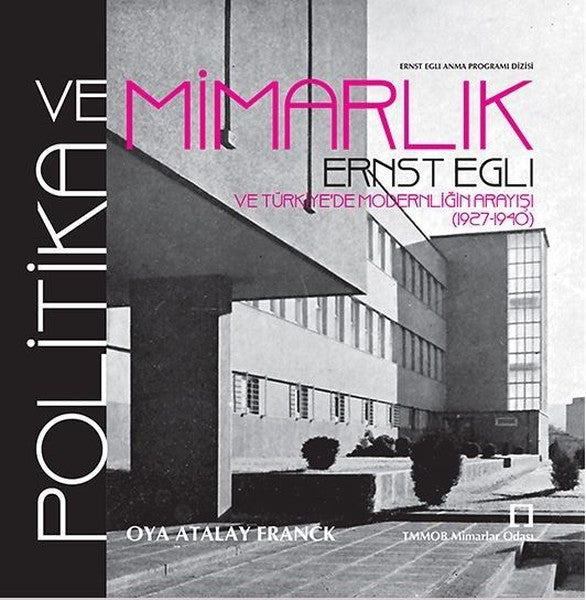
Politics and Architecture
600.00TL
800.00TL
%25 İndirimli
Yazar: Oya Atalay Franck
Brand: Mimarlar Odası Yayınları
Basım Tarihi: 2015
Basım Dili:
Sayfa Sayısı: 190Boyut: 13.5 x 19.5 cm
In stock
9786050107586
Share:
Product Description
Oya Atalay Franck's book, Politics and Architecture: Ernst Egli and the Quest for Modernity in Turkey (1927-1940), is the first comprehensive and primary source research on Ernst Arnold Egli (1893-1974), who lived in our country from 1927 to 1940. Egli made numerous critical, constructive, and assimilating contributions to Turkish architectural education as an educator, to architectural practice with his designs for educational, cultural, industrial, and residential buildings, and to the formation of cities with the plans he envisioned and discussed, as well as with his writings. Ernst Arnold Egli was a multifaceted architect. The historical period he lived in saw the transformation of world architecture with the "Modern Movement"; the country he 'moved to' was transitioning from a seven-century-old empire to a Republic; in this chaotic environment, his close relationship with Atatürk led to him being commissioned to innovate the architectural education program at the School of Fine Arts, then newly named the Academy of Fine Arts, and to establish and manage the Project Office of the Ministry of National Education. This describes a quite privileged position for his own experience and role. This rich, privileged, and complex situation makes it possible to examine his presence among the founding political actors of the period as a 'foreign architect' under the following headings: 1. Society, Politics, and Architecture in the Turkish Context; 2. Essays on the Synthesis of Modern and Traditional Architecture; 3. Architecture as the "Symbol of Functionality"; 4. Modern Architecture and the Representation of State Power; 5. Originality as a Result of Synthesis; 6. Towards an Independent Modernism. The author divides Egli's work in Turkey into four phases: Between 1927-30, he focused on adapting modern architectural understanding to regional conditions, characterized by early experiments. Between 1930-34, the expression of already learned regional values was made less prominent to establish a purer, more refined architectural language. Between 1934-36, he primarily dealt with public building design, and the search for "representation" and "the representation of power" formed the main intellectual contribution of his architectural language. Between 1936-40, due to his resignation from the deanship and the Head of the Ministry of National Education Office, architectural design demands decreased; he engaged in city planning. "Another Modern!"... This is the epithet the author uses for Egli, whom she describes as the architect of a moderate and contextual modernism. It is clear that this quality is meticulously elaborated and explained in the book in a comprehensive manner, encompassing national-international, contemporary-historical, internal-external, peer-pioneering, official-unofficial positions, characteristics, and developments. Ali Cengizkan * The text is an abridged excerpt from Ali Cengizkan’s foreword to the Turkish edition of the book.
