
Fundamentals of Design
Yazar: Ali Seylan
Brand: YEM Yayın
Basım Tarihi: Ekim 2023
Basım Dili:
Sayfa Sayısı: 200Boyut: 16.5 x 23 cm
In stock
9786058043442
Product Description
YEM Yayın has published a new book titled Basic Design, which aims to serve as a fundamental and preparatory resource in the academic programs of higher education institutions offering fine arts, architecture, and design education.
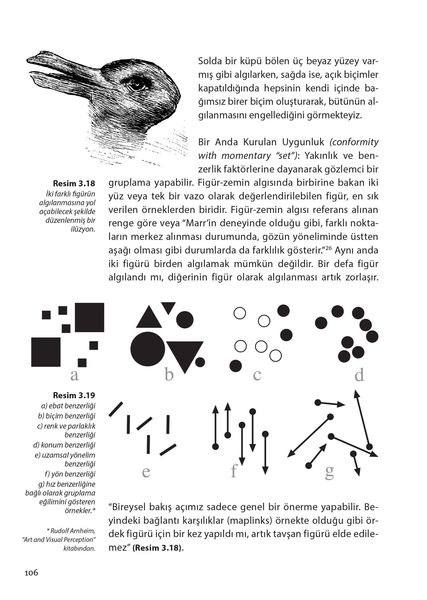
The book Basic Design evaluates the purpose, function, and current understanding of “Basic Design” education through a historical projection, from the Bauhaus, where it first appeared in the curriculum, to the present day.
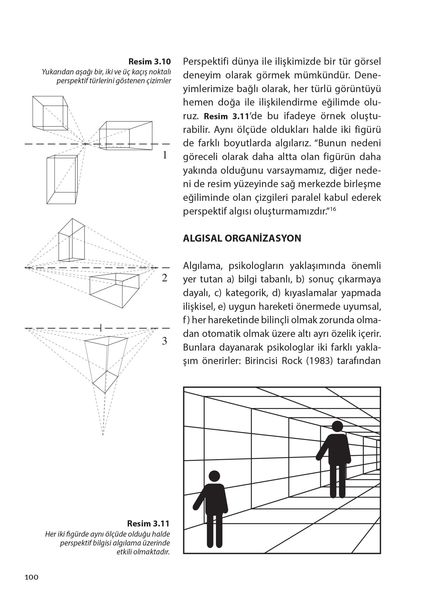
The fundamental dynamic of science and art is formed by the interaction of human beings, the subject of these fields of activity, with objects. In this context, the book addresses the human potentials that are decisive in comprehending objects and in all existential endeavors, as well as the perception mechanisms and their functioning that form the basis of creative actions. Among all perceptual inputs, visual perception, which has the highest proportion, is examined in detail for its foundational role in the visual arts.
The book aims to present “Basic Design” education as an essential discipline that, by its very nature, opposes rules, prejudices, traditional and conventional educational approaches, and instead prepares for the future and requires continuous renewal. Basic concepts are discussed in a way that avoids rigid definitions or prescriptive guidelines, and examples are chosen solely for their explanatory value in illustrating the subject.
Prof. Dr. Ali Seylan, the author of the book, which aims to assist young people beginning their art and design education at the very start of the process, states the following in summary:
“Art education is seen as a complex process determined by the unique aspects of art, and the subjective dimensions of art educators and students. This multifaceted environment in which it must develop turns art education into a problematic area. The 'Basic Design' course, which serves as an introduction/starting point for art education, has the identity of a discipline that aims to provide students with theoretical and practical foundational gains for the future. An educational activity, regardless of the characteristics of the individual, group, or mass it targets, and their levels of readiness, is expected to fulfill the functions of progressively ensuring knowledge acquisition, skill acquisition and development, and the acquisition of attitudes, behaviors, and dispositions where the gains from previous stages form a special value and direction. Therefore, the aim is for students who undergo this process to be able to develop a systematic approach to art and artistic problems with these fundamental gains, and to see their connections with the gains of other courses.”
CONTENTS
PART I - BASIC DESIGN EDUCATION 16
Definition of Basic Design Course 22
Rationale and Aims of the Basic Design Course within the Framework of General Objectives of Art Education 24
BASIC DESIGN EDUCATION PRACTICES DURING THE BAUHAUS PERIOD 32
Itten’s Basic Design Education Practices 32
Albers-Nagy and Basic Design Education Practices 36
Klee-Kandinsky and Basic Design Education Practices 40
Russian Industrial Art Schools: VKHUTEMAS, a Parallel Development and Interaction with Bauhaus 44
POST-BAUHAUS DEVELOPMENTS 46
Black Mountain College 46
Chicago (New Bauhaus) School 47
Gestalt School/Ulm School of Design 48
Reflections of Bauhaus and the Art Education Movement on Our Education System 49
PART II - HUMAN'S INTERNAL DYNAMICS / NATURAL ENDOWMENTS AS THE SUBJECT OF DESIGN EFFORT 57
Development of Analytical Thinking Ability and Creativity 65
Phenomenon of Consciousness: Impression-Sensation-Perception-Consciousness 67
Mental Processes and Cognition 74
Cognition-Affection and Thinking 78
Convergent and Divergent Processes in Cognitive Skills 79
Convergent and Divergent Thinking Abilities 79
Creation in the Context of Perception-Imagination and Thinking 80
Learning-Teaching Equation in the Development of Analytical Thinking Ability and Creativity 81
Educator Profile for Creative Problem Solving 84
PART III - PHYSIOLOGICAL AND PSYCHOLOGICAL FOUNDATIONS OF VISUAL PERCEPTION 92
PHYSIOLOGY OF VISUAL PERCEPTION 92
BINOCULAR SYSTEM AND DEPTH PERCEPTION 94
PERCEPTUAL ORGANIZATION 100
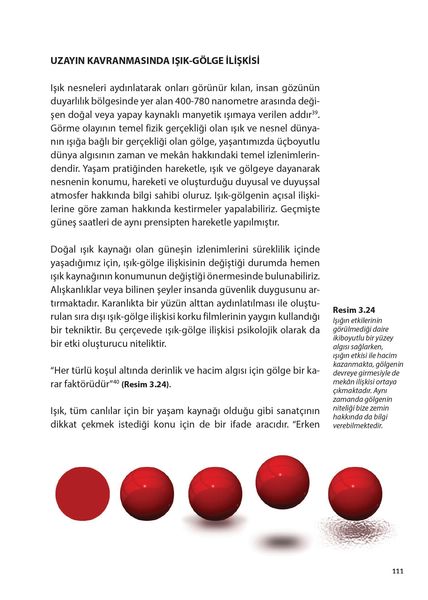
LIGHT-SHADOW RELATIONSHIP IN THE COMPREHENSION OF SPACE 111
COLOR SENSATION 112
Color Theories 113
Color Mixing Methods 117
Contrast Theory and Relativity in Color 121
Color Perception as a Process of Meaning-Making 124
PART IV - METHODOLOGICAL AND THEORETICAL PROPOSALS FOR THE IMPLEMENTATION OF THE BASIC DESIGN COURSE 127
Point 127
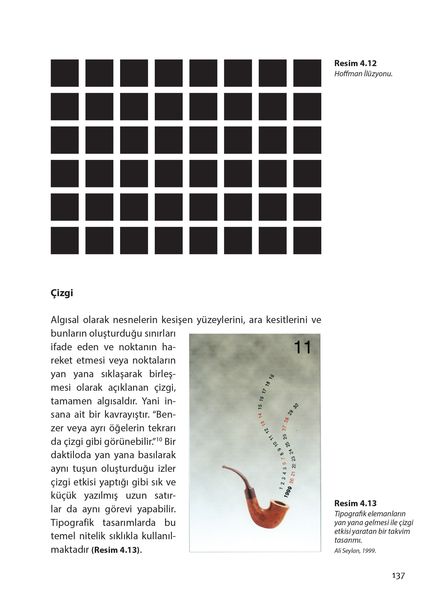
Line 137
Surface 143
Form 146
Color 162
CATEGORIES OF VISUAL EFFECT IN THE PERCEPTION PROCESS 176
Movement/Motion 176
Rhythm 179
Balance 180
Harmony/Cohesion/Accord 183
BIBLIOGRAPHY 193
