




Achieving the Impossible: The Journey of 10,000 People
Yazar: Rıdvan Akar (Metin ve Araştırma)
Brand: YEM Yayın
Basım Tarihi: Aralık 2020
Basım Dili:
Sayfa Sayısı: 412Boyut: 16.5 x 24.0 cm.
In stock
9786257008259
Product Description
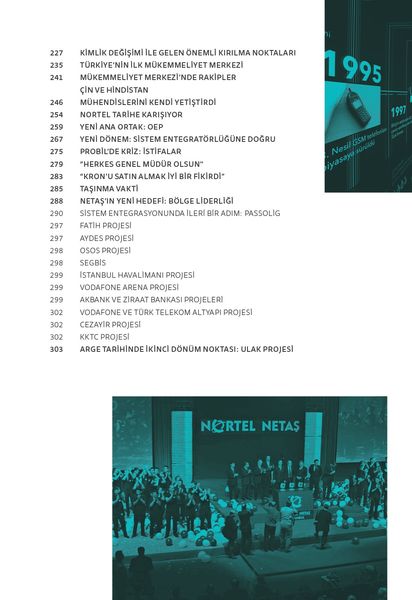
The book begins on a June day in 1875, with Alexander Graham Bell's invention of the telephone. This is followed by the establishment of the Post Directorate during the Ottoman period; the launch of PTT with the young Republic; Netaş's establishment in the 1960s, taking the lead in communication; and Netaş overcoming economic, technological, political, and social challenges to continuously develop and innovate, reaching its current inspiring leadership position...
Beyond merely chronicling a corporate history, Rıdvan Akar, who undertook the research and authored the texts for this highly valuable work documenting Turkey's technological history, states the following in the book's "Introduction" section:
"...Corporate history research gained importance in our country after the 1990s. The fact that only 75 companies in Turkey have a 100-year history, and the disappearance of vast corporate histories with the passing of 'founders,' spurred a curiosity to pursue those traces, paving the way for such research...
Corporate culture at Netaş was not something merely spoken of, but something lived and written, a history that reproduced itself each time. In this context, looking at Netaş's story, we can see interesting milestones. In its establishment and development process, Netaş was a multinational partnership. But interestingly, its counterpart in Turkey was not profitability, but necessities and needs. Netaş was established to address the communication problems and gaps, which were among the country's most significant issues.
One of the main differences that set Netaş apart from its peers was that it was 'ownerless.' Of course, Netaş had owners, but we mean those who 'embraced' it. This was a reflex related to the sense of belonging and responsibility we emphasized above. During the company's development and growth, especially during the periods of Turkish general managers, the employees' feeling of a 'national duty' rather than just a 'job' was the key to this embracing process..."
